
The Real Cost of Business Video Production: Agency vs In-House vs AI
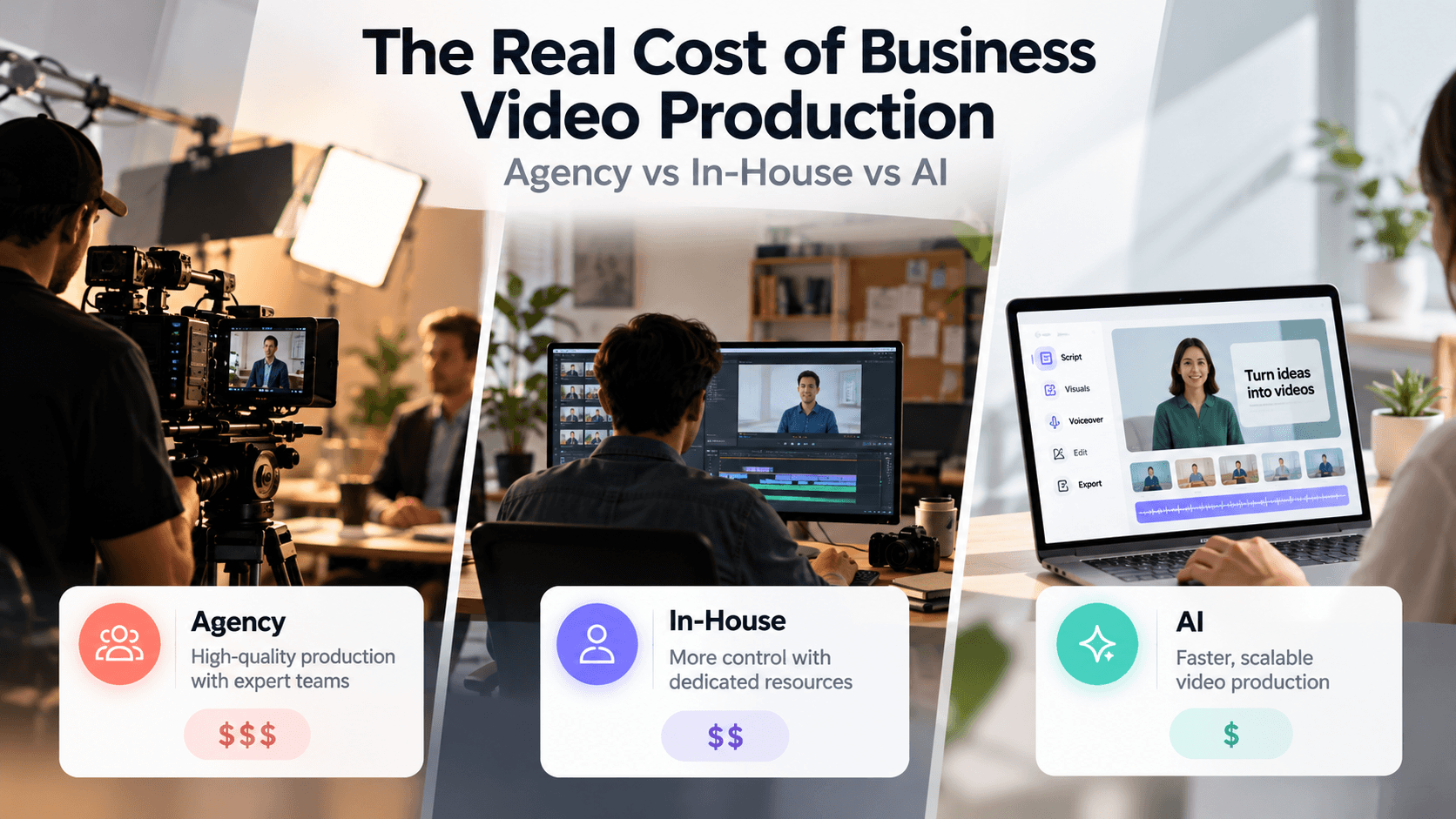
Producing a business video can cost anywhere from a few hundred dollars to tens of thousands. The difference depends on who creates it, how complex it is, and how often you need new content.
Traditionally, businesses had two choices: hire a video production agency or build an in-house team. AI video production has added a third option, letting teams create professional videos without the same equipment, staffing, or production requirements.
But comparing these options based on price alone can be misleading.
A $5,000 agency video may require additional spending when information changes. An in-house team costs money even during quieter production periods. AI tools still need people to guide content and review results.
So, which approach offers the best value?
Let's compare the real cost of business video production, including the expenses that rarely appear in initial estimates.
What Goes Into the Cost of Business Video Production?
Before comparing agencies, internal teams, and AI platforms, it helps to understand where production budgets actually go.
Most business videos involve four stages:
- Pre-production: Research, scripting, creative planning, storyboarding, and approvals.
- Production: Filming, recording voiceovers, creating visuals, and gathering assets.
- Post-production: Editing, animation, sound design, subtitles, and revisions.
- Maintenance: Updating outdated information, changing visuals, and creating new versions.
Each stage requires time, tools, and people.
For example, creating a product explainer may involve a product manager explaining the feature, a marketer preparing the script, a designer creating visuals, and an editor assembling the video.
Even if editing costs $500, the business has spent considerably more when you include everyone's working hours.
This is why total production cost matters more than the initial quote.
Agency Video Production: How Much Does It Cost?
Hiring a professional video production agency is a common choice for businesses that need polished, high-quality content.
According to Synthesia's video production cost guide, mid-level video projects can cost approximately $3,000 to $10,000. More complex productions can reach $10,000 to $50,000 or higher.
These are broad market estimates, not fixed prices. The final amount depends on video length, filming requirements, animation, talent, and editing complexity.
What Are You Paying For?
Agency fees typically cover:
- Creative direction, scripting, and storyboarding
- Professional filming equipment and production crews
- Editing, animation, sound design, and finishing
- Project management and production coordination
The biggest advantage is access to specialized talent without hiring an entire production team.
Agencies are especially useful for brand campaigns, customer testimonials, executive interviews, and videos that require original footage.
Where Do Agency Costs Add Up?
The challenge appears when businesses need frequent videos or revisions.
Suppose your company produces 12 training videos at $5,000 each. That's $60,000 before additional versions or future updates.
If your processes change six months later, revising those videos may require another round of agency coordination, editing, and approvals.
Agency production also depends on external schedules. Even a small change may take longer when multiple projects are already in progress.
Best suited for: High-value brand videos, professional filming, and occasional projects where production quality justifies a larger budget.
In-House Video Production: Is It More Affordable?
Building an internal production team gives businesses greater control over their content.
Instead of paying an agency for every project, companies hire employees who handle video production regularly.
However, the initial investment can be substantial.
What Does an In-House Video Team Cost?
According to the U.S. Bureau of Labor Statistics, the median annual wage for film and video editors was $75,420 in May 2025.
That's the salary for one role, not an entire production team.
Businesses may also need to budget for:
- Cameras, microphones, lighting, and recording equipment
- Editing software, storage, and subscriptions
- Motion designers, scriptwriters, or additional production specialists
- Employee benefits, training, and equipment maintenance
Even a small team can represent a significant annual commitment.
When Does In-House Production Make Sense?
An internal team can be cost-effective when video production is frequent and predictable.
For example, a SaaS company producing weekly product demonstrations may benefit from having someone who understands its product, brand guidelines, and customers.
The team can also respond quickly to feedback without coordinating with an external agency.
However, production capacity remains limited by available working hours.
If the company suddenly needs 30 training videos for a major rollout, its existing team may struggle to deliver everything on time.
Best suited for: Businesses with consistent video needs, regular filming, and enough volume to justify dedicated employees.
AI Video Production: What Does It Actually Cost?
AI video production changes the economics by reducing the manual work involved in creating videos.
Instead of coordinating separate tools and specialists for every production stage, businesses can use AI to assist with scripting, visuals, voiceovers, animation, and editing.
The upfront cost is generally lower than hiring an agency or establishing a production team.
But AI video production isn't free.
What Are the Main AI Video Production Costs?
Businesses should account for:
- Monthly or annual software subscriptions
- Usage credits, rendering limits, or additional generation costs
- Employee time spent preparing content and reviewing outputs
- Brand setup, revisions, and quality checks
Pricing varies significantly between platforms. A basic video generator may cost much less than an enterprise production platform with advanced workflows and collaboration features.
The important difference is how much work the platform actually handles.
A tool that generates individual clips may still leave your team responsible for scripting, assembling scenes, adding motion graphics, and managing revisions.
An end-to-end platform can reduce more of that production effort.
How GaiN Approaches Business Video Production
GaiN uses an AI-native production workflow that helps business teams turn ideas and organizational knowledge into videos.
Its AI agents support research, scripting, storyboarding, scene creation, motion, voiceovers, and rendering.
Teams can also guide changes with natural-language instructions, keeping creative control without managing every production step manually.
For example, an L&D manager could turn an existing SOP into a training video, review the result, and request changes when the process is updated.
This approach is especially relevant for businesses that produce repeatable content, such as product explainers, onboarding modules, and sales enablement videos.
Human review still matters, especially when videos contain technical information, compliance requirements, or customer-facing claims.
Best suited for: Businesses that need frequent, repeatable videos and want to reduce production dependencies while retaining control over their content.
Agency vs In-House vs AI: Video Production Cost Comparison
Here's how the three approaches compare across common business requirements:
Factor | Agency | In-House | AI |
|---|---|---|---|
Initial investment | High per project | High setup and hiring costs | Usually lower |
Recurring costs | Project fees or retainers | Salaries and overhead | Software, usage, and labor |
Production speed | Depends on agency schedules | Depends on team capacity | Often faster for suitable formats |
Creative control | Shared with agency | High | High with human direction |
Revisions | May cost extra | Requires employee time | Requires review time and possibly credits |
Scalability | Requires more agency capacity | Limited by staffing | Scales with platform and review capacity |
Ideal Use | Premium productions | Regular internal production | Repeatable business videos |
Example: Producing 24 Business Videos Annually
Consider a company planning to create 24 product and training videos over one year.
Using hypothetical planning assumptions:
Production Model | Estimated Annual Cost | Cost Per Video |
|---|---|---|
Agency at $5000/video | $120,000 | $5,000 |
In-House Production Budget | $120,000 | $5,000 |
AI: $6,000 software + $200 labor/video | $10,800 | $450 |
These figures illustrate how costs can change with production volume. They are not vendor quotes or guaranteed savings.
The comparison also assumes similar video requirements and approved outputs. Complex filming, extensive revisions, or additional review could change the results.
Still, it demonstrates why production volume matters when evaluating costs.
The Hidden Costs Businesses Often Overlook
The initial production budget tells only part of the story. Several less visible expenses can affect the overall return on investment.
1. Content Updates and Revisions
Business information changes constantly.
Product interfaces get redesigned. Compliance requirements evolve. Sales messaging changes.
If updating a video requires another filming session or extensive editing, maintenance can become expensive.
2. Subject-Matter Expert Time
A technical expert may spend hours explaining processes, reviewing scripts, and correcting inaccuracies.
That time costs money, even when it doesn't appear on a production invoice.
3. Approval and Coordination Delays
Videos often pass through marketing, legal, product, and leadership teams before publication.
Every additional handoff can delay delivery, particularly when revisions require external coordination.
4. Localization and Multiple Versions
Businesses serving different markets may need translated voiceovers, subtitles, or region-specific messaging.
Producing several versions of the same video can significantly increase the workload.
5. Missed Business Opportunities
A product launch video delivered after release loses value.
Similarly, outdated training materials can slow employee onboarding.
These costs are difficult to quantify, but they matter when evaluating production efficiency.
Which Video Production Model Should Your Business Choose?
The right approach depends on what you're producing and how frequently you need it.
Choose an agency when you need original filming, specialized creative expertise, or a major brand campaign.
Choose an in-house team when video production is a consistent business function, and you need dedicated people available for filming and editing.
Choose AI-assisted production when your priority is producing and updating business videos frequently without expanding production resources at the same rate.
A hybrid approach can also work well.
For example, a company might hire an agency for its annual brand film, use an internal team for customer interviews, and rely on AI for training, product updates, and sales content.
The goal isn't to replace every production method. It's to use the right resources for each video.
Conclusion
The real cost of business video production goes beyond equipment, editing, and agency fees. It includes employee time, revisions, production delays, and ongoing maintenance.
Agencies offer specialized expertise. In-house teams provide direct control. AI-assisted platforms can make frequent business video production more accessible and efficient.
For teams producing videos regularly, the best solution is often the one that makes creating and updating content easier, not simply the one with the lowest upfront cost.
Frequently Asked Questions
1. How much does a corporate video cost?
Corporate video production can range from a few thousand dollars to $50,000 or more for complex agency projects. Costs depend on video length, production quality, filming requirements, and revisions.
2. Is AI video production cheaper than traditional production?
AI video production can be considerably cheaper for repeatable formats such as training videos, explainers, and product updates. However, businesses should include software fees, human review, and revision costs when comparing options.
3. Can AI replace a professional video production team?
AI can automate or simplify many production tasks, but it cannot replace every filming or creative requirement. Businesses may still need professional teams for live-action campaigns, interviews, and complex productions.
4. What is the most cost-effective way to produce business videos?
AI-assisted video production is often the most cost-effective option for businesses that regularly create training, product, and sales videos. For occasional high-end projects requiring professional filming, hiring an agency may offer better value.
5. How can businesses reduce video production costs without sacrificing quality?
Businesses can reduce costs by reusing existing content, planning scripts carefully, and using AI tools to simplify production and editing. Maintaining clear brand guidelines and reviewing videos before publishing also helps reduce expensive revisions.
Arindam M— Technical and AI Content Writer
Building the AI production layer for enterprise video.