AI Video Generator vs AI Video Production Platform: What Is the Difference?
AI can generate a video in minutes. But generating a video and producing one aren't quite the same.
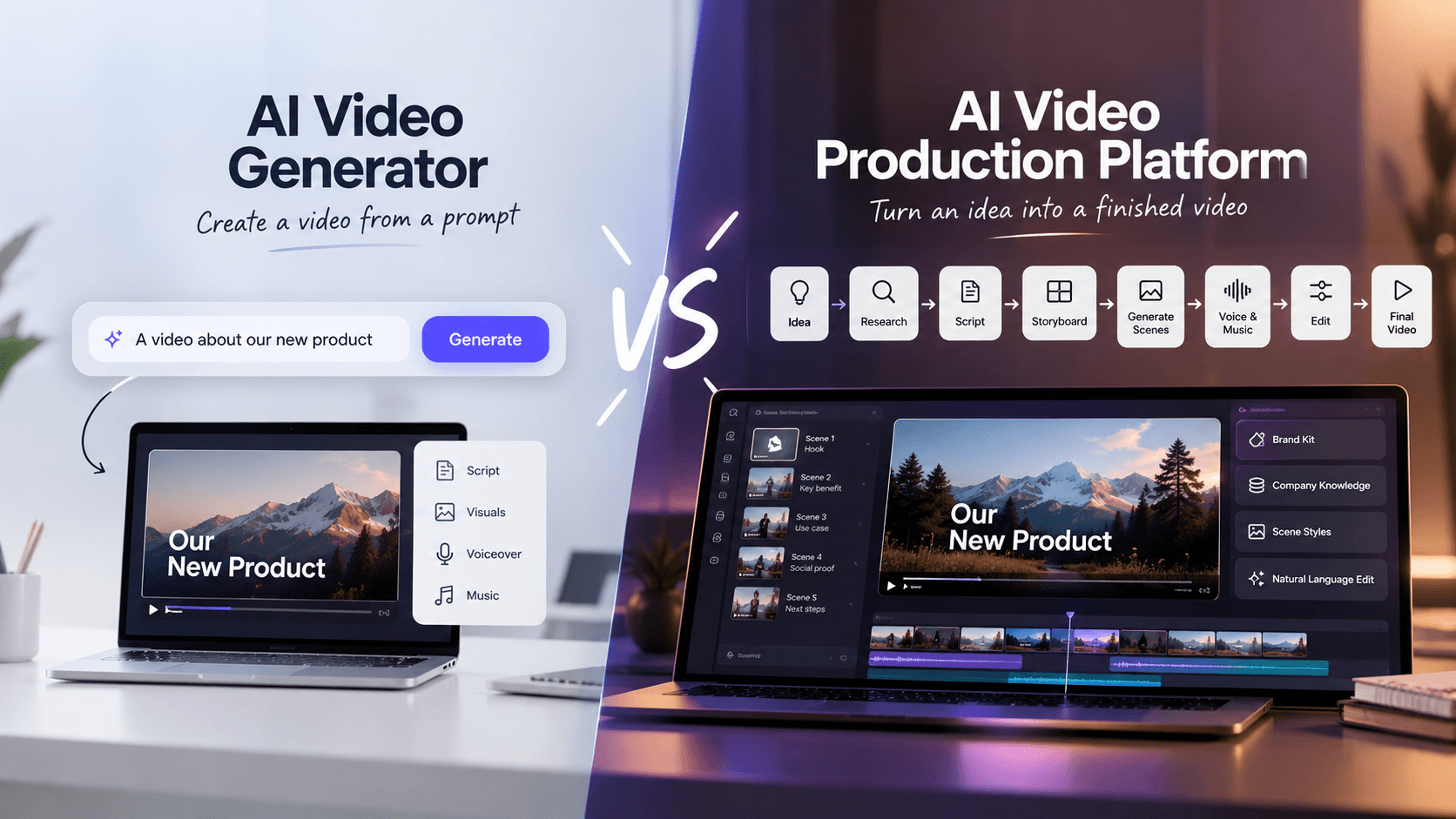
An AI video generator creates video from an input such as a prompt, script, image, or document. An AI video production platform handles more of the process of turning an idea into a finished video.
That process can include research, scripting, storyboarding, scene planning, visual creation, voiceover, music, editing, brand context, and final rendering.
The distinction matters because businesses rarely need a random video clip. A product marketing team needs a launch video that explains the right message. An L&D team needs training that reflects an actual process. A sales enablement team needs content that matches current positioning.
In each case, generating visuals is only part of the job.
What is an AI video generator?
An AI video generator is software that uses AI to create video from an input.
Depending on the tool, that input might be:
- A text prompt
- A script
- An image
- A presentation
- An existing video
- A document
You provide the material or instructions, and the tool generates a video or video assets from them.
Modern AI video generators can do much more than create a few seconds of footage. Some can add avatars, voices, subtitles, stock footage, branding, multiple scenes, and basic editing.
That is why “AI video generator” no longer automatically means a simple tool.
The more useful question is: How much of the work surrounding generation does the tool handle?
If your team still has to research the topic, write the narrative, plan the scenes, move assets between tools, assemble everything, and manage revisions separately, AI has made generation easier. It has not necessarily solved video production.
What is an AI video production platform?
An AI video production platform connects more of the steps involved in making a finished video.
Instead of starting and ending with:
Prompt → Generate → Video
the workflow may look more like:
Idea → Research → Script → Storyboard → Scenes → Voice and music → Edit → Render
The important difference isn't simply having more features.
It is whether those stages work together as one production process.
For example, research can shape the script. The script can guide the storyboard. The storyboard can determine what each scene needs to communicate. Brand and company knowledge can guide the visuals and language. Feedback can then be applied without rebuilding the production from scratch.
Generation still happens. It is simply one part of a larger process.
That makes an AI video production platform particularly useful when the difficult part isn't creating something. It is consistently creating the right thing.
AI video generator vs. AI video production platform
Here is the difference at a glance:
AI Video Generator | AI Video Production Platform |
|---|---|
Primarily generates video or video assets | Handles a larger part of video production |
Often starts with a prompt, script, image, or document | Can start with an idea, brief, or business knowledge |
Focuses heavily on the generated output | Connects planning, creation, and editing |
Context may need to be supplied for each project | Can carry brand and company context into production |
The user may plan the story and scenes separately | Can help structure scripts, stories, and scenes |
Revisions may rely heavily on regeneration or manual editing | Supports revisions within the wider production |
Useful for standalone creative tasks | Useful for repeatable business video production |
The two categories overlap.
A video generator can include editing tools. A production platform can include several types of video generation. And a sophisticated generator may cover a large portion of a production workflow.
So the distinction is better understood as scope rather than a strict product label.
Ask what happens before and after the video is generated. That usually tells you more than what the software calls itself.
The hidden difference: creation work vs. coordination work
This is where the difference becomes clearer for business teams.
Video production involves creation work.
Someone has to write the script, create visuals, record narration, animate scenes, and edit the video.
But it also involves coordination work.
Someone has to make sure the script reflects the brief. Each scene has to support the story. Visuals need to match the brand. Feedback has to reach the right scene. Product information needs to stay accurate. Late changes shouldn't break everything around them.
AI video generators can dramatically reduce creation work.
But if your team is still manually connecting all those pieces, much of the coordination work remains.
An AI video production platform tries to reduce both.
For business teams producing video regularly, that can be the more meaningful shift. The goal isn't just to generate a scene faster. It is to reduce the effort between “We should make a video about this” and “The video is ready.”
When is an AI video generator enough?
Not every team needs a complete production platform.
An AI video generator may be enough when you:
- Need an occasional video or clip
- Already have a finished script
- Know exactly what visuals you want
- Are testing creative ideas
- Create standalone social content
- Have an existing editing workflow you are happy with
- Don't mind moving between different tools
Suppose your marketing team needs a five-second product visual for a social post. There may be little reason to introduce an entire production process.
Give the generator clear instructions, get the asset you need, and move on.
The value of a production platform increases as the work around generation increases.
When does an AI video production platform make more sense?
Consider a product marketing team preparing for a feature launch.
They don't just need footage.
They need to decide what matters about the feature, turn that into a clear story, create the script, decide what viewers should see at each point, produce the scenes, add narration and music, follow brand guidelines, review the result, and make changes before launch.
Or consider an L&D team turning an internal SOP into training.
The important part isn't merely generating attractive visuals. The video has to understand the material, organize it clearly, explain the process correctly, and stay consistent with the organization's language.
A production platform becomes more useful when:
- Video is created regularly rather than occasionally
- Each video contains multiple connected scenes
- Company knowledge needs to inform the content
- Brand consistency matters
- Scripts and storyboards take significant time
- Videos go through frequent revisions
- Teams are creating training, explainers, product videos, or sales content
- Too much time is spent moving work between tools
At that point, faster generation alone may not solve the real bottleneck.
How should you evaluate an AI video production platform?
Don't start with the longest feature list.
Instead, take one real video your team produces today and ask where the platform enters and where it stops.
- Can you begin with an idea, or do you need to arrive with a completed script?
- Does it help research and structure the message?
- Can it build a storyboard before expensive generation begins?
- Does it understand your brand guidelines and company knowledge?
- Can it decide which type of visual makes sense for each scene?
- Can you change one scene without rebuilding everything else?
- Can a non-editor request a change in normal language?
And finally: How much work is still left after the AI says the video is generated?
Those questions reveal whether you're looking at a powerful generation tool or something closer to a production system.
From AI video generation to AI video production
AI video generation has already made creating visuals much faster. The next problem is connecting those capabilities into a process businesses can actually use repeatedly.
That is the idea behind GaiN.
Instead of treating generation as the entire job, GaiN connects the stages around it. You can start with an idea, use web research and organization knowledge to develop it, build a script and storyboard, generate motion graphics and cinematic scenes, add voice and music, and make changes using natural-language instructions.
The goal isn't to remove people from video production.
It is to remove the manual work between their idea and the finished video.
Frequently Asked Questions (FAQ's)
1. Can an AI video generator create a complete video?
Yes. Many AI video generators can now create multi-scene videos with visuals, voiceovers, music, captions, avatars, and basic editing. The difference is not simply whether the tool can produce a finished video. An AI video production platform typically handles more of the work around generation, such as research, scripting, storyboarding, brand context, scene planning, revisions, and production.
2. What should businesses look for when choosing an AI video platform?
Start with your existing video workflow rather than a feature list. Look at how the platform handles scripting, storyboarding, brand consistency, company knowledge, scene creation, voice and music, editing, revisions, and collaboration. Most importantly, ask how much manual work remains between your initial idea and the finished video.
3. Can AI video tools replace traditional video production?
AI video tools can replace or reduce many time-consuming production tasks, particularly for training videos, product explainers, sales content, internal communications, and other repeatable business videos. Traditional production may still make more sense for projects requiring physical filming, actors, highly specific locations, or complex creative direction. For many business use cases, the bigger change is that teams can produce more videos without depending on a full traditional production process every time.
4. What is the difference between an AI video generator and an AI video editor?
An AI video generator creates new video content from inputs such as text, images, scripts, or documents. An AI video editor helps modify or assemble video content, such as removing backgrounds, adding captions, changing scenes, or trimming footage. An AI video production platform can include both generation and editing while also covering earlier stages such as research, scripting, and storyboarding.
5. Are AI video production platforms better for business teams?
They're more useful when video production is a recurring business process rather than an occasional creative task. Teams in product marketing, L&D, sales enablement, HR, and customer education often need videos to follow company knowledge, messaging, and brand guidelines while remaining easy to update. In those cases, connecting the entire production workflow can matter more than simply generating individual video assets faster.
Arindam M— Technical and AI Content Writer
Building the AI production layer for enterprise video.